
 0
0
 0
0
Energy demand is growing faster than ever. At the same time, climate change is pushing the world to find cleaner and more reliable alternatives to fossil fuels. Solar power has already become popular, but it still has one big limitation—it depends on weather and daylight.
That’s where space-based solar power comes in. It sounds like science fiction, but it’s quickly becoming a serious topic among scientists, governments, and tech companies.
So what exactly is it, and why are experts calling it the future of energy? Let’s break it down in a simple way.
What is Space-Based Solar Power?
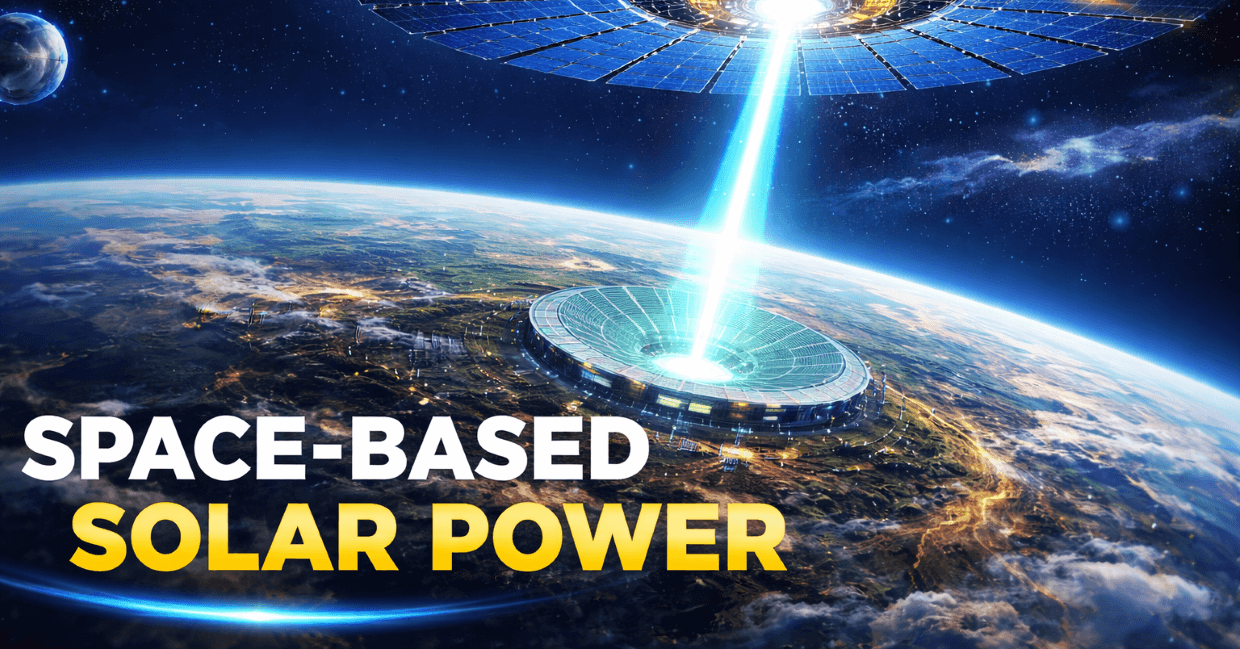
Space-based solar power (SBSP) is the idea of collecting solar energy in space and sending it back to Earth.
Instead of placing solar panels on rooftops or land, large solar satellites are placed in orbit around Earth. These satellites capture sunlight continuously and convert it into electricity.
The energy is then transmitted wirelessly—usually using microwaves or lasers—to receiving stations on Earth.
In simple terms:
- Solar panels in space collect energy 24/7
- Energy is converted into a transferable form
- It is sent down to Earth without wires
Why Space is Better for Solar Power?
Solar panels on Earth face several problems:
- Nighttime stops energy production
- Clouds and weather reduce efficiency
- Dust and pollution block sunlight
In space, none of these issues exist.
1. Constant Sunlight
Satellites in orbit can receive sunlight almost all the time, without interruptions from night or weather.
2. Higher Efficiency
Solar radiation in space is stronger and more consistent than on Earth, making energy generation more efficient.
3. No Land Usage
Unlike solar farms that require large land areas, space-based systems don’t compete for land.
How Does Space-Based Solar Power Work?
The process may sound complex, but it can be understood in three main steps:
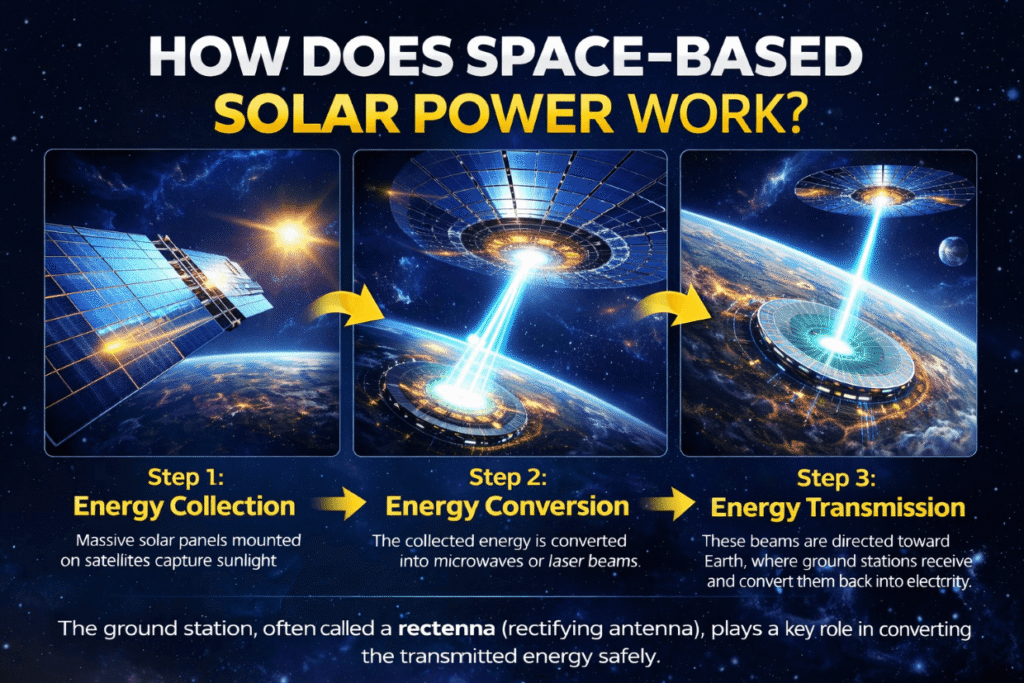
Step 1: Energy Collection
Massive solar panels mounted on satellites capture sunlight.
Step 2: Energy Conversion
The collected energy is converted into microwaves or laser beams.
Step 3: Energy Transmission
These beams are directed toward Earth, where ground stations receive and convert them back into electricity.
The ground station, often called a rectenna (rectifying antenna), plays a key role in converting the transmitted energy safely.
Benefits of Space-Based Solar Power
This technology has some huge advantages that could change the energy industry completely.
1. Unlimited Clean Energy
The sun provides more energy in one hour than the world uses in a year. Space-based systems could tap into this nearly unlimited resource.
2. 24/7 Power Supply
Unlike traditional solar power, SBSP works day and night, providing continuous electricity.
3. Reduced Carbon Emissions
Since it’s a renewable energy source, it can significantly reduce dependence on fossil fuels.
4. Energy Access Anywhere
Energy can be beamed to remote areas, disaster zones, or regions without infrastructure.
5. Stable Energy Output
No fluctuations due to weather means more predictable and reliable power.
Challenges Holding It Back
Even though the idea is exciting, there are still major challenges to overcome.
1. High Cost
Launching satellites into space is expensive. Building and maintaining large solar arrays in orbit adds to the cost.
2. Technology Limitations
Wireless power transmission over long distances still needs improvements for efficiency and safety.
3. Space Debris Risk
Satellites are vulnerable to space debris, which could damage expensive equipment.
4. Energy Loss
Some energy is lost during transmission from space to Earth.
5. Public Concerns
People often worry about microwave beams and their safety, even though scientists say they are designed to be harmless.
Is It Safe?
Safety is one of the biggest concerns.
The energy beams used are designed to be low-intensity and spread out. They are not strong enough to harm humans, animals, or aircraft.
In fact:
- The beams are weaker than direct sunlight
- Systems automatically shut down if alignment is lost
- Ground stations are placed in controlled areas
So while the idea may sound risky, it’s being designed with safety as a top priority.
Countries and Companies Working on It
Several countries are already investing in space-based solar power.
United States
Research is ongoing with support from government agencies and private companies.
China
China plans to build a working SBSP station by the 2030s and has already started testing.
Japan
Japan has been working on wireless energy transmission for years and is making steady progress.
Europe
The European Space Agency is actively exploring the feasibility of space solar power systems.
Private companies are also entering the space, hoping to make this technology commercially viable.
When Will It Become Reality?
Right now, space-based solar power is still in the experimental stage. However, progress is happening faster than before.
Experts believe:
- Small-scale systems could appear by 2030
- Larger commercial projects may be ready by 2040
It may take time, but the foundation is already being built.
How It Could Change the World?
If successfully developed, space-based solar power could transform how we produce and consume energy.
1. Ending Energy Shortages
Countries with limited resources could access clean energy from space.
2. Reducing Electricity Costs
Once infrastructure is built, energy could become cheaper over time.
3. Supporting Smart Cities
Continuous power supply can support AI systems, electric vehicles, and smart infrastructure.
4. Disaster Relief
Energy could be sent instantly to areas affected by natural disasters.
Space-Based Solar Power vs Traditional Solar
| Feature | Traditional Solar | Space-Based Solar |
|---|---|---|
| Availability | Daytime only | 24/7 |
| Weather Impact | High | None |
| Efficiency | Medium | High |
| Land Requirement | High | None |
| Cost | Lower upfront | High initial cost |
Both have their place, but space-based solar power could solve the biggest limitations of current solar technology.
Should We Invest in It?
This is a big question.
Some critics argue that the cost is too high and that improving Earth-based renewable energy is a better option.
But others believe that:
- Energy demand will keep rising
- Land-based solutions have limits
- Space offers a long-term solution
The truth likely lies in a combination of both approaches.
Final Thoughts
Space-based solar power is no longer just a futuristic idea. It’s becoming a serious solution to one of the world’s biggest problems—clean and reliable energy.
Yes, there are challenges. Yes, it will take time. But the potential benefits are too big to ignore.
If the technology becomes practical and affordable, it could provide unlimited clean energy for generations to come.
The next decade will be crucial. What happens now in research and investment will decide whether this idea stays in the lab or becomes part of everyday life.
FAQ
1. What is space-based solar power in simple terms?
Space-based solar power is a system where solar panels are placed in space to collect sunlight and send that energy back to Earth wirelessly. It allows energy generation without interruptions from night or weather.
2. How is energy transmitted from space to Earth?
The energy collected in space is converted into microwaves or laser beams and then transmitted to Earth. Ground stations receive this energy and convert it into usable electricity.
3. Is space-based solar power safe for humans?
Yes, it is designed to be safe. The energy beams are low-intensity and spread over a large area, making them harmless to humans, animals, and aircraft. Safety systems are also built in to prevent accidents.
4. Why is space better than Earth for solar energy?
Space offers constant sunlight without clouds, pollution, or nighttime interruptions. This means solar panels in space can generate energy almost 24/7, making them far more efficient.
5. What are the biggest challenges of space-based solar power?
The main challenges include high costs of launching equipment, improving wireless energy transmission, and protecting satellites from space debris. These issues are being actively researched.
6. Which countries are working on space-based solar power?
Countries like the United States, China, Japan, and members of the European Space Agency are actively researching and developing this technology.
7. When will space-based solar power become available?
Small-scale projects could start appearing around 2030, while large commercial systems may take until 2040 or later to become widely available.
8. Can space-based solar power replace traditional energy sources?
It has the potential to become a major energy source, but it is more likely to work alongside other renewables like wind and traditional solar rather than fully replacing them.
9. Is space-based solar power expensive?
Currently, it is very expensive due to the cost of space launches and technology development. However, costs are expected to decrease as technology improves.
10. How could space-based solar power help remote areas?
Energy can be transmitted wirelessly to remote or disaster-affected regions where building power infrastructure is difficult, making it a powerful solution for global energy access.