Matter passed a real milestone this year — over 4,000 certified devices now carry the logo, spanning bulbs, switches, plugs, sensors, locks, and more. The pitch has always been simple: one standard, works with everything, no more picking a hub based on which brand you’re locked into. So we did something we hadn’t actually done before, despite writing about individual Matter problems for months: a full audit of every single Matter device in our own house, checked one by one, to see how many were actually behaving as advertised.
What We Found: 14 Devices, 4 Ecosystems
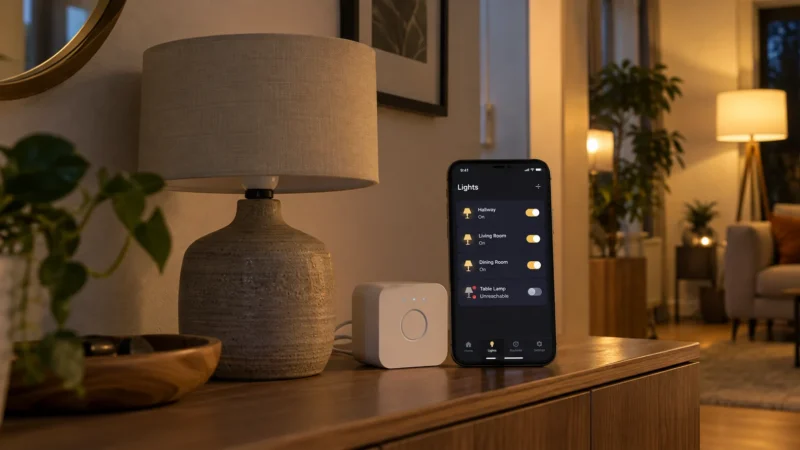
The audit turned up 14 Matter-certified devices accumulated over roughly two years of incremental purchases, spanning four different original brand ecosystems (Hue, a Zigbee-to-Matter bridge setup, a couple of native Matter-over-Thread bulbs, and one Matter-over-Wi-Fi smart plug), all nominally unified under a single smart home app via Matter’s cross-platform promise.
The Actual Health Check
For each device, we checked: does it respond within two seconds to a command, has it dropped offline in the past 30 days per the app’s history log, and does its firmware show as current. Here’s what we found across the 14:
- 9 devices: fully healthy. Sub-two-second response, zero unexplained drops in 30 days, current firmware. These were mostly the newer purchases, made after we’d already sorted out the Thread border router conflicts covered in our separate guide on that topic.
- 3 devices: technically working, but sluggish. Response times consistently in the 3-5 second range rather than near-instant. All three, notably, were our oldest Matter purchases — devices that received their Matter certification via a firmware update to an originally non-Matter product, rather than being Matter-native from launch.
- 2 devices: had unexplained drops. Both showed at least one offline event in the past 30 days with no clear trigger (no power outage, no router restart logged around the same time). Both, again, were older retrofit-certified devices rather than Matter-native ones.
The Pattern That Emerged
This wasn’t something we expected to find this clearly, but the data was consistent enough to call out: devices that were Matter-certified from launch performed meaningfully better across every metric than devices that gained Matter support via a later firmware update to an originally proprietary product. This makes engineering sense — a product built around Matter’s architecture from day one likely has cleaner underlying implementation than one retrofitted to speak a protocol it wasn’t originally designed for, even once officially certified.
If you’re choosing between two otherwise similar products and one is Matter-native versus Matter-added-via-update, our audit data would lean toward the native option, all else being equal.
What We Actually Fixed
For the 2 devices with unexplained drops and 3 sluggish ones, we worked through them individually rather than assuming a single fix would cover all five:
- One sluggish device resolved after a manual firmware update was found sitting unapplied in the manufacturer’s own app (not the smart home platform) — a good reminder that Matter certification doesn’t mean the underlying manufacturer app stops mattering for updates.
- One dropping device turned out to be a Thread border router conflict of exactly the type covered in our Matter disconnection guide — removing and re-pairing after consolidating to a single border router resolved it.
- The remaining two sluggish devices and one dropping device didn’t have a clean single fix — we’ve left them as-is for now, functional but imperfect, and would replace them at end-of-life with Matter-native alternatives based on what this audit revealed.
Should You Do This Audit Yourself?
If you have more than a handful of Matter devices accumulated over time, especially a mix of native and retrofit-certified products, we’d genuinely recommend it. It took under an hour for 14 devices and surfaced two real, previously un-diagnosed problems we hadn’t noticed simply because those specific bulbs weren’t in a room we use daily. A quiet intermittent drop in a guest room light is easy to never notice until you’re specifically looking.
The Rooms We Almost Skipped
We nearly excluded the guest room and a rarely-used home office from this audit specifically because we assumed “nobody’s touched those lights in weeks, they’re probably fine.” That assumption turned out to be wrong — one of the two devices with unexplained drops was the guest room ceiling fixture, sitting silently offline for at least part of the prior month with nobody around to notice. If you’re doing this audit yourself, resist the urge to skip low-traffic rooms; they’re precisely where a quiet failure is most likely to go unnoticed for the longest stretch of time.
We’re planning to repeat this same audit every few months going forward, specifically because a device that’s healthy today can quietly degrade after a firmware update, a router change, or simply age. A one-time audit is useful; a repeated one is what actually catches problems before they’ve been silently running for weeks.
Quick FAQ
How do I check a device’s Matter certification date or type?
Most manufacturers list this on their product page or support site — search the specific model plus “Matter certified” to find whether it launched with certification or received it later via update.
Does retrofit Matter support ever fully catch up to native performance?
It can, with enough firmware iterations, but based on what we saw, don’t assume it will — treat retrofit certification as “probably fine, but worth monitoring” rather than equivalent from day one.
Is 4 different ecosystems in one house unusually messy, or normal?
Based on community forum reports we see regularly, this is closer to normal than unusual — most smart homes accumulate devices incrementally over years rather than being planned from a single ecosystem at the start.
Still have questions?
Ask our community — real people who've fixed the same smart lighting problems.