
 0
0
 0
0
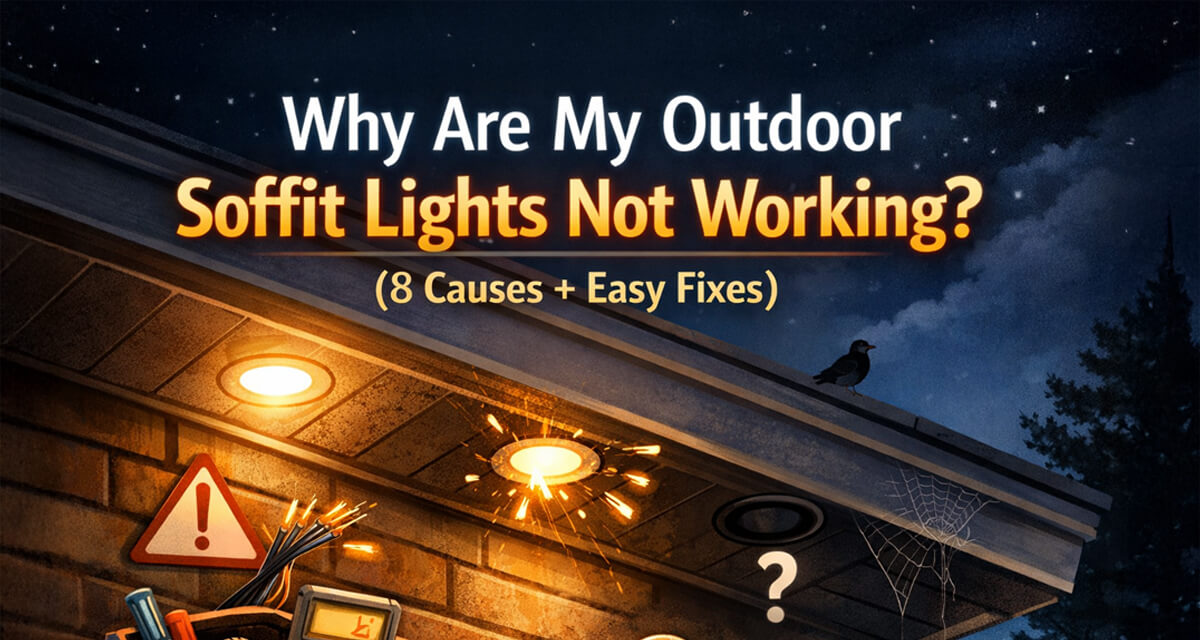
I know how frustrating it feels — your outdoor soffit lights were working perfectly, and now they are just dark. Do not worry. Why Are My Outdoor Soffit Lights Not Working?
You do not need to call an electrician straight away.
We have put together this simple guide to help you find the problem fast. Most soffit light failures come down to just 8 common causes.
You can fix most of them yourself in less than 30 minutes. Let us go through them one step at a time — starting with the easiest checks first.
What Are Outdoor Soffit Lights, and Why Do They Stop Working?
Soffit lights are small lights fitted into the underside of your roof overhang. We call that underneath part the “soffit.” These lights shine down onto your walls, front door, driveway, and garden.
Since they sit outside all year long, they face a lot of problems:
✅ Rain and moisture getting inside
✅ Very hot or very cold temperatures
✅ Insects building nests inside the fittings
✅ Wires getting old and worn out over time
The good news? Most of the time, the fix is simple. Let us go through each cause now.
1. Check the Circuit Breaker First
This is the first thing we always check — and it takes less than one minute.
Go to your electrical panel (the metal box on your wall with all the switches). Look for any switch that has moved to the “off” position or is stuck halfway between on and off. This is called a tripped breaker, and it is one of the most common reasons all your soffit lights go off at the same time.
How to Fix It
✅ Find the tripped switch in your electrical panel
✅ Flip it fully to “off” first
✅ Then flip it back to “on”
✅ Go outside and test your soffit lights
⚠️ Important: If the breaker trips again straight away, stop and call an electrician. This means there is a bigger electrical problem that needs a professional to look at.
2. Check the GFCI Outlet
You might not know about this one — but it trips more often than people think.
A GFCI outlet is a special safety socket. It has two small buttons on it labelled “Test” and “Reset.” We usually find these near garages, bathrooms, and outside walls. Many outdoor soffit lights run through one of these outlets. If it trips, your lights go off completely.
How to fix it:
✅ Find the GFCI outlet connected to your outdoor lights
✅ Press the “Reset” button firmly
✅ You should hear a small click
✅ Test your soffit lights again
If the GFCI outlet keeps tripping every time you reset it, water has probably got into a connection somewhere. You will need an electrician to check it safely.
3. The Bulb Has Burned Out
Sometimes the answer is the simplest one — the bulb is just dead.
We see this most often with older halogen or incandescent bulbs. These types of bulbs do not last very long, especially outdoors where temperatures change a lot between day and night.
How to fix it:
✅ Turn off the circuit breaker for that light
✅ Carefully remove the old bulb
✅ Put in a new bulb with the same wattage and voltage shown on the fitting
✅ Turn the power back on and test
We always recommend switching to LED bulbs if you have not already. LED bulbs last up to 25,000 hours, use much less electricity, and handle outdoor weather far better than older bulb types.
You can find our full guide to exterior soffit lighting ideas and bulb choices on our Lighting Guides page.
4. Water or Moisture Has Got Inside the Fixture
Soffit lights sit right under the roofline. Rain, morning dew, and humidity can slowly work their way inside the fitting over time. Once water gets in, it causes rust, short circuits, and complete failure.
Signs of water damage:
✅ You can see rust or dark marks on the fitting
✅ There is fogging or condensation inside the glass cover
✅ You smelled something burning the last time the light was on
✅ The metal socket inside looks green or white and crusty
How to fix it:
Turn off the power at the breaker
✅ Remove the fitting carefully
✅ Look inside for rust, water marks, or damaged seals
✅ Clean any crusty contacts with a small wire brush or sandpaper
✅ Seal the fitting again with silicone before putting it back
If the fitting is cracked or the seal is broken beyond repair, replace it with a new one rated IP65 or higher. This rating means the fitting is properly protected against water and is safe for outdoor soffit use.
5. The Fixture Is Not Rated for Outdoor Use
This surprises a lot of people. If your soffit lights were put in by a previous owner, there is a chance they used indoor light fittings outside. Indoor fittings are not weatherproof, and they break down very quickly when they get wet or face temperature changes.
How to check:
✅ Look on the fitting for a label that says “Wet Rated,” “Damp Rated,” or an IP number
✅ Wet-rated fittings can handle direct rain
✅ Damp-rated fittings are fine for covered soffits where rain does not hit directly
✅ No rating at all usually means it is an indoor fitting — replace it
Using indoor fittings outside is also a fire risk, so we recommend replacing them as soon as possible.
6. Loose or Corroded Wiring Connections
Outdoor wires go through a lot of stress every single year. Heat in summer makes wires expand. Cold in winter makes them shrink. All this movement slowly loosens the connections inside the junction box. Insects like wasps and ants also love to nest in soffit spaces, and they can chew through wire insulation.
Symptoms of wiring issues:
✅The light works sometimes but not always
✅ It flickers a few times and then goes out
✅ Several soffit lights on the same row all stop working together
How to fix it:
Turn off the circuit breaker — this is very important before touching any wires
✅ Open the junction box (the small box the wires connect inside)
✅ Tighten any loose wire connections
✅ Look for green or white powder on the copper wires — that is corrosion
✅ Replace any corroded connectors with new waterproof ones made for outdoor use
If you see melted plastic, black marks, or burnt wires — do not touch them. Turn off the power and call a licensed electrician straight away.
We also have a helpful article on why lights flicker and what the warning signs mean that goes into more detail on wiring faults.
7. A Faulty or Dirty Photocell Sensor
Many outdoor soffit lights have a tiny sensor called a photocell. This sensor watches how bright it is outside. When it gets dark, it turns your lights on. When it gets light in the morning, it turns them off.
If the sensor gets dirty or picks up light from a nearby street lamp or porch light, it can think it is daytime all the time — and keep your soffit lights switched off all night.
How to test it:
✅ Cover the sensor completely with your hand or a piece of dark tape
✅ If the light turns on straight away, the sensor is the problem
✅ It is either dirty, broken, or confused by a nearby light source
How to fix it:
✅ Wipe the sensor lens gently with a soft cloth and a little rubbing alcohol
✅ Make sure no other light shines directly onto the sensor
✅ If cleaning does not work, replace the photocell — they are very cheap
If your motion sensor light is also not turning on, we cover those fixes too on our Sensor Technology page.
8. The Dimmer Switch Is Incompatible With LED Bulbs
If you recently changed your soffit bulbs to LEDs but kept your old dimmer switch, this is very likely your problem.
Old dimmer switches were made for incandescent bulbs. They do not work properly with LED technology. When they are mismatched, your lights might flicker, buzz, stay dim, or simply not turn on at all.
How to fix it:
✅ Replace your old dimmer switch with one that says “LED compatible” on the box
✅ Lutron and Leviton both make good LED-compatible dimmers
✅ Check your LED bulb packaging too — it will show the minimum and maximum dimmer wattage it works with
✅ Make sure your dimmer and bulb wattage ranges match
Quick Diagnosis Table
| All soffit lights out at once | Tripped breaker or GFCI | Reset breaker / GFCI |
| One light out | Burned-out bulb | Replace bulb |
| Lights flicker then die | Loose wiring or failing bulb | Check connections |
| Light works intermittently | Loose wire or corroded contact | Tighten and clean connections |
| Light won’t turn on at night | Dirty or failed photocell | Clean or replace sensor |
| Rust or water inside fixture | Moisture intrusion | Reseal or replace fixture |
| Lights dim or won’t turn on after bulb swap | Incompatible dimmer | Replace with LED dimmer |
| Burning smell from fixture | Water damage or wiring fault | Turn off power, call electrician |
When to Call an Electrician
Most of the fixes above are safe DIY jobs as long as you turn off the circuit at the breaker before We want you to fix things safely. Most of the steps above are perfectly safe to do yourself. However, please call a licensed electrician if:
✅ The circuit breaker trips again every time you reset it
✅ You find burnt, melted, or damaged wires inside the junction box
✅ More than one circuit in your home is affected
✅ The lights are very high up and you are not comfortable on a ladder
✅ You smell burning coming from the wall or ceiling
Working with 120V household electricity without proper training is dangerous. If you are unsure about anything, it is always better to get a professional.
How to Stop This Happening Again
Once your lights are working again, a small amount of maintenance goes a long way:
Once your lights are working again, we recommend these simple maintenance steps to keep them running longer:
✅ Check seals once a year — especially after heavy rain or winter. Re-seal any gaps with outdoor-rated silicone caulk
✅ Wipe the lens cover once or twice a year with a damp cloth to keep the light bright
✅ Only use IP65-rated fittings when replacing any outdoor soffit light
✅ Switch to LED bulbs — they last much longer, run cooler, and handle weather changes far better. See our solar and LED lighting guides for tips
✅ Get wiring checked every 5 years — especially in older homes, or after any big storm
FAQ: Outdoor Soffit Lights Not Working
Why do all my soffit lights go out at the same time?
When all your soffit lights stop working together, the problem is almost always at the power source — a tripped breaker, a blown fuse, a tripped GFCI outlet, or a broken transformer. We always start at the electrical panel before checking anything else.
Can rain cause soffit lights to stop working?
Yes. Heavy rain can drive moisture into fixture housings, junction boxes, and connection points — especially on older installations with deteriorated seals. Always check for water ingress after a storm if your lights stop working.
How do I know if my soffit light fixture needs replacing?
If the housing is cracked, the socket contacts are heavily corroded, or water has got inside repeatedly despite resealing, it is time for a new fixture. Choose a wet-rated or damp-rated recessed soffit light with an IP65 rating as a minimum.
Is it safe to fix soffit lights myself?
Most bulb replacements and sensor cleanings are safe DIY tasks. Any work involving wiring inside a junction box should only be done with the circuit breaker off and confirmed using a non-contact voltage tester. If you are unsure, call an electrician — outdoor electrical faults can cause fires.
Why does my soffit light work sometimes but not others?
Intermittent issues like this usually come from a loose wire somewhere. When the temperature changes, wires expand and contract a bit, so a weak connection can randomly make contact and then lose it again.
It’s worth opening the junction box and checking all the connections, tightening anything that feels loose.