
 0
0
 0
0
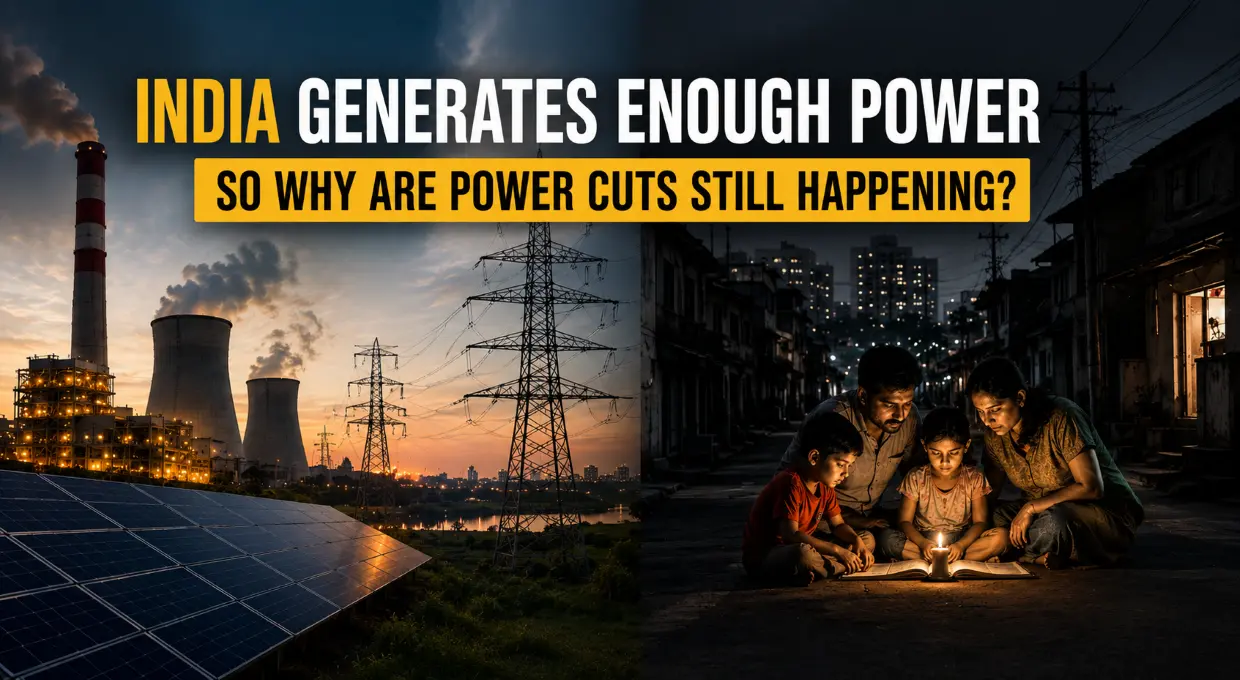
India Generates Enough Power, at least on paper. That’s the confusing part for millions of people dealing with sudden outages during hot afternoons or late-night blackouts.
Electricity production in the country has grown massively over the last decade, yet power cuts still disrupt homes, businesses, hospitals, and factories across many regions.
The real issue isn’t always electricity generation anymore. Distribution failures, overloaded local grids, financial losses, and weak infrastructure create a much bigger problem than most people realize.
⚡ Quick Summary
India produces massive amounts of electricity, yet power cuts still happen regularly in many areas. This guide explains the real reasons behind the gap between power generation and reliable electricity delivery.
India Generates Enough Power — But That’s Only Half the Story
India has become one of the world’s largest electricity producers. Massive coal plants, solar parks, hydroelectric stations, and wind projects have expanded electricity generation capacity at an impressive pace.
Reports from the Central Electricity Authority regularly show that the country often has enough installed capacity to meet national demand.
That sounds like good news.
The frustrating reality begins after electricity gets generated.
Power still needs to travel through transmission networks, substations, transformers, and local distribution systems before it reaches homes and businesses. A large part of India’s electricity problem exists inside that delivery chain.
The Real Problem Starts With Distribution Failures
Many people hear “power shortage” and assume power plants aren’t producing enough electricity.
That’s no longer the biggest issue in many states.
Weak distribution systems create a major portion of India’s outages today.
⚠️ Why Local Electricity Systems Fail
Even when enough electricity is generated nationally, local infrastructure problems can still cause frequent outages and unstable supply.
A city may technically receive enough electricity from the grid, yet certain neighborhoods still experience repeated outages because local systems cannot handle demand properly.
Real-World Scenario
A residential area adds hundreds of new air conditioners over a few years, but transformer capacity remains unchanged.
Summer arrives.
Demand spikes sharply in the evening.
The transformer overheats repeatedly, leading to scheduled or sudden power cuts even though the state itself may have enough electricity available.
That situation happens across many parts of India.
India Generates Enough Power, But Transmission Losses Remain Huge
Electricity losses during transmission and distribution continue hurting the system financially.
Some losses occur naturally while electricity travels long distances. Others happen because of theft, outdated infrastructure, or poor metering systems.
State electricity boards lose massive revenue because a portion of supplied electricity never gets billed properly.
That missing revenue creates another cycle of problems.
Infrastructure upgrades slow down. Maintenance gets delayed. Utilities struggle financially. Consumers eventually face unreliable electricity supply.
| Problem Area | What Happens | Impact on Consumers |
|---|---|---|
| Old Transformers | Equipment overheats | Frequent outages |
| Power Theft | Revenue losses rise | Delayed upgrades |
| Weak Distribution Networks | Supply instability | Voltage drops and cuts |
| Peak Summer Demand | Grid overload | Load shedding |
Now things become even more complicated during extreme weather.
Summer Heat Pushes India’s Grid to Dangerous Limits
India Generates Enough Power during many periods of the year, but heat waves create sudden demand explosions.
Air conditioners, water pumps, refrigerators, industrial cooling systems, and commercial buildings start consuming massive electricity simultaneously.
Evening hours become especially stressful for the grid.
Why Evening Power Cuts Happen More Often
Electricity demand usually peaks after sunset.
That creates a difficult balancing challenge because solar energy production drops sharply at exactly the same time household consumption rises.
Coal plants help stabilize supply, but they cannot always increase output instantly.
Local transformers and feeders often struggle first.
That’s why entire neighborhoods sometimes lose electricity during the hottest evenings of summer.
Renewable Energy Growth Helps — But Storage Is Still a Weak Spot
India has aggressively expanded renewable energy infrastructure.
Large solar parks and wind projects now contribute significant electricity to the national grid.
The challenge comes from inconsistency.
Solar plants stop producing electricity after sunset. Wind energy changes depending on weather conditions. Large-scale battery storage systems remain expensive and limited.
Practical Limitation Most People Ignore
A state may produce abundant solar power during the afternoon but still face shortages at night.
Battery infrastructure remains one of the biggest missing pieces in India’s clean energy transition.
Pro Insight:
Renewable energy alone does not guarantee uninterrupted electricity. Strong storage systems, smart grids, and modern transmission infrastructure matter just as much as generation capacity.
Coal Still Carries Most of India’s Electricity System
Despite renewable growth, coal remains the backbone of India’s power supply.
That creates another layer of vulnerability.
Railway delays, coal shortages, transportation bottlenecks, and maintenance shutdowns can quickly create stress across multiple states.
A few years ago, several thermal power plants faced dangerously low coal inventories even though India Generates Enough Power capacity overall.
The country had infrastructure.
Fuel supply disruptions created the real crisis.
Rural Areas and Urban Cities Experience Power Cuts Differently
Power reliability in India depends heavily on location.
Large cities usually receive priority because of:
- Hospitals
- IT infrastructure
- Commercial demand
- Industrial zones
- Government facilities
Rural regions often face:
- Longer outages
- Scheduled load shedding
- Slower repairs
- Lower voltage supply
- Delayed infrastructure upgrades
That uneven development creates two very different electricity realities inside the same country.
Financial Problems Inside State Utilities Keep Growing
State electricity distribution companies, commonly called DISCOMs, remain under severe financial pressure in many regions.
Subsidized electricity programs help consumers but also create long-term financial strain if reimbursement systems fail or delays increase.
Mistake That Continues Repeating
Several utilities sell electricity below sustainable recovery cost.
Losses increase year after year.
Infrastructure modernization slows down because utilities struggle to invest consistently in upgrades and maintenance.
Consumers eventually pay the price through unreliable supply.
Now here’s where things get more practical.
Smart Grids and Infrastructure Modernization May Be the Real Solution
India Generates Enough Power in many situations already.
The next challenge involves delivering electricity efficiently and reliably.
⚡ What India Needs for Reliable 24/7 Electricity
Building a stable nationwide electricity system requires major upgrades across infrastructure, storage, and power management.
Some cities have already started implementing smarter electricity management systems with promising results.
Nationwide transformation will still take years.
Decision Guide: What’s Actually Causing Most Power Cuts in India?
| Possible Cause | How Common It Is | Main Impact |
|---|---|---|
| Lack of Generation | Less common now | Large-scale shortages |
| Distribution Failure | Very common | Local outages |
| Transmission Overload | Common during summer | Voltage instability |
| Fuel Supply Issues | Occasional | Regional stress |
| Extreme Weather | Increasing rapidly | Grid failures and equipment damage |
Read Also: What benefits do solar and wind power have over the use of fossil fuels?
Can India Finally Achieve Reliable 24/7 Electricity?
India Generates Enough Power to move much closer toward stable nationwide supply than ever before.
The bigger challenge now involves execution.
Infrastructure upgrades, smarter grids, stronger local distribution systems, battery storage expansion, and financial reform will decide how reliable electricity becomes over the next decade.
Several states have already shown impressive improvement.
Others still struggle with aging infrastructure and rapidly growing demand.
That gap explains why electricity reliability can feel completely different depending on where someone lives.
Read Also: Mind-Blowing Portable Solar Systems on Trains: The Future Hack for City Lights!
FAQ: India Generates Enough Power
Why are power cuts still happening if India Generates Enough Power?
India Generates Enough Power at the national level in many periods of the year, but electricity still needs to move through local transformers, substations, and distribution networks. Old infrastructure, overloaded systems, and transmission losses often trigger outages even when total electricity production remains sufficient.
Does India actually produce surplus electricity?
Yes, several states produce surplus electricity during certain seasons. India has significantly expanded coal, solar, hydro, and wind generation capacity over the last decade. The larger issue now involves distribution efficiency rather than pure electricity generation.
What is the biggest reason behind power cuts in India?
Distribution failure remains one of the biggest reasons. Weak local grids, overloaded transformers, electricity theft, poor maintenance, and financially stressed DISCOMs create supply instability across many areas.
Why do power cuts increase during summer?
Electricity demand rises sharply during heat waves because millions of air conditioners, coolers, refrigerators, and water pumps operate simultaneously. Local transformers and feeders often cannot handle sudden evening demand spikes.
Why do rural areas face more electricity outages?
Urban centers usually receive higher priority because of hospitals, industries, commercial zones, and IT infrastructure. Rural regions often have older distribution systems, lower infrastructure investment, and slower maintenance response times.
Does renewable energy solve India’s electricity problem?
Renewable energy helps increase clean electricity production, but it does not completely eliminate outages. Solar energy production drops after sunset, while wind energy depends on weather conditions. Strong battery storage systems and smarter grids are still needed.
What are DISCOMs and why are they important?
DISCOMs are electricity distribution companies responsible for delivering power to homes and businesses. Financial losses, unpaid subsidies, electricity theft, and outdated infrastructure often weaken their ability to maintain reliable supply.
Why does electricity voltage fluctuate during peak hours?
Voltage fluctuations usually happen when local demand becomes too high for transformers or distribution feeders. Summer evenings often create severe stress on neighborhood electricity systems.
Can smart grids reduce power cuts in India?
Yes, smart grids can improve electricity reliability by detecting faults faster, balancing demand more efficiently, and reducing overload risks. Several Indian cities have already started implementing smart grid technology.
Will India achieve 24/7 uninterrupted electricity in the future?
India is moving closer to reliable nationwide electricity supply, but major infrastructure upgrades are still required. Better transmission systems, stronger local grids, modern substations, battery storage expansion, and DISCOM reforms will play a critical role.
Why do some neighborhoods get electricity while nearby areas face outages?
Different areas may depend on separate transformers, feeders, or local distribution systems. One overloaded transformer can create repeated outages in a single locality while nearby areas continue receiving stable supply.
How does electricity theft affect power cuts?
Electricity theft increases financial losses for utilities and overloads local systems unexpectedly. That reduces available revenue for maintenance and infrastructure upgrades, which eventually affects supply reliability.
Why does India still depend heavily on coal for electricity?
Coal remains the largest and most stable electricity source for India because it can provide large-scale continuous power. Renewable energy is growing rapidly, but storage infrastructure is still limited for nationwide reliability.
How do transmission losses impact electricity supply?
Transmission losses reduce the amount of electricity that actually reaches consumers. High losses weaken utility finances and increase stress on the overall electricity system.
What improvements can reduce power cuts permanently?
Several long-term solutions can improve reliability:
✓ Smart grid implementation
✓ Better transformer capacity
✓ Faster maintenance systems
✓ Stronger battery storage
✓ Modern substations
✓ Reduced electricity theft
✓ Financial reform for DISCOMs
✓ Upgraded rural distribution infrastructure